surveys · 2026-10-28
2 m and 70 cm band survey, one night at home
What the 2 m and 70 cm amateur bands look like from my home in Turku, locator KP10CL, over one night: 2026-10-28 19:43 to 2026-10-29 07:43 local time.
2m70cmsdrrtl-sdrsurveyrepeaters
LocationKP10CL (home, Turku)
ReceiverRTL-SDR Blog V4
AntennaDiscone
Run12 h, 10 min blocks
2 m144–146 MHz, 36 dB
70 cm430–440 MHz, 40 dB
The receiver alternated 10-minute blocks of 2 m and 70 cm, so each band has about 6 hours of data. Each row of the waterfall is a 30 s average. Levels are relative dB, not calibrated dBm.
Interactive pages
2 m band, 144–146 MHzSpectrum, waterfall, detected signals and local repeaters. 1.6 MB.
70 cm band, 430–440 MHzSpectrum, waterfall and detected signals. 4 MB.
Drag on a plot to zoom, double-click to reset. Click a row in a signal table to zoom to it.
Overview
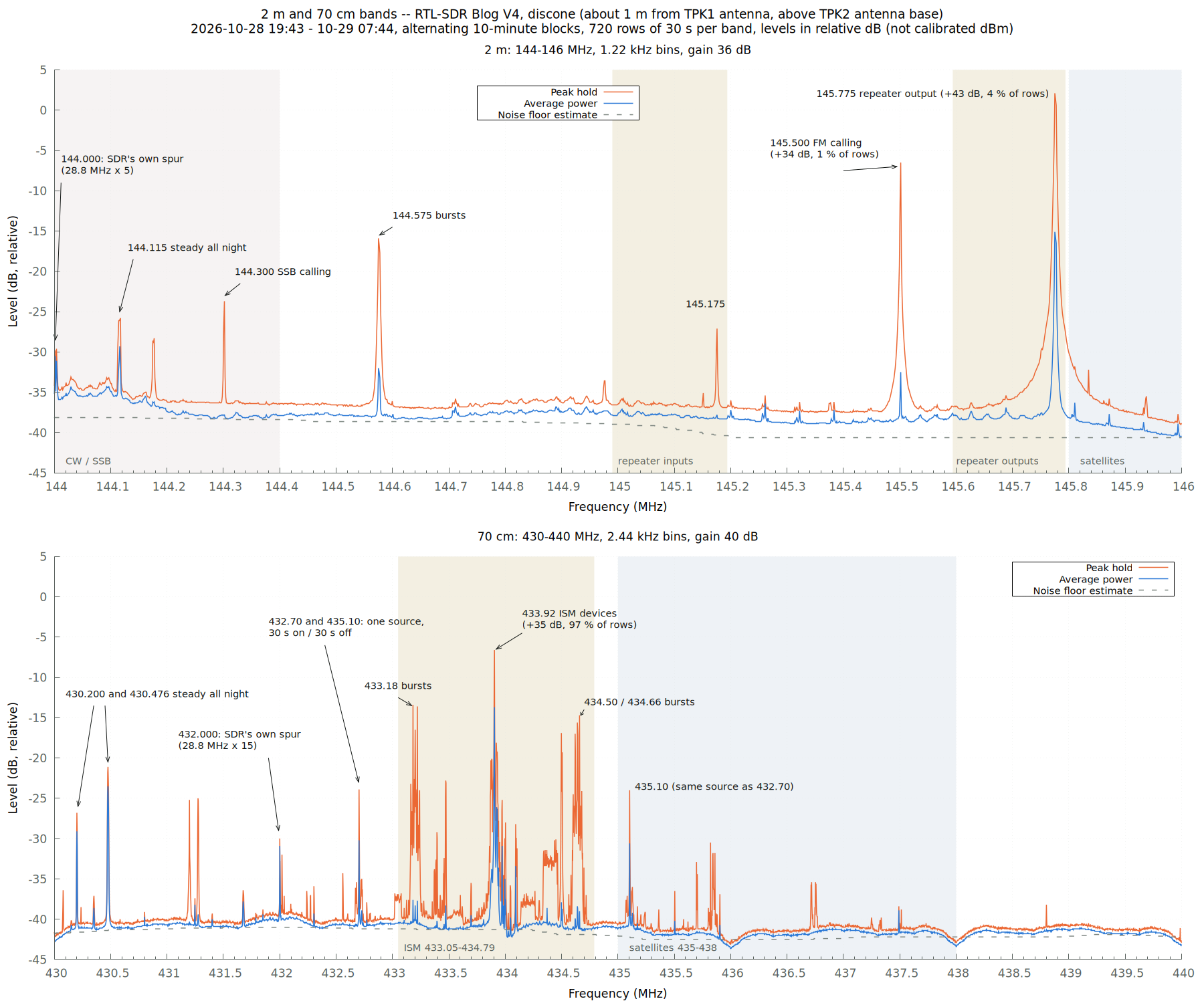
What showed up
2 m
- The strongest signal was the OH1RAU repeater output on 145.775 MHz (Turku, Pääskyvuori, about 7 km away), up to +43 dB above the floor. Its input on 145.175 MHz shows the stations talking to it.
- 145.500 MHz FM calling was used now and then, up to +34 dB.
- 144.115 MHz is a steady carrier all night. Its source is unknown.
- 144.000 MHz is the SDR's own spur, the 5th harmonic of its 28.8 MHz crystal.
- APRS on 144.800 MHz did not show. A packet lasts under a second, so a 30 s average hides it.
70 cm
- 433.92 MHz ISM devices (sensors, remote controls) were active in 97 % of rows.
- 432.703 and 435.104 MHz switch on and off together, 30 s on and 30 s off, all night. One unknown source sends both.
- 430.200 and 430.476 MHz are steady carriers. Their source is unknown.
- 432.000 MHz is the SDR's own spur, the 15th harmonic of its crystal.
Raw data
rtl_power output, one line per frequency hop per 30 s. Gzip-compressed CSV.