863–873 MHz SRD band survey: MeshCore and LoRaWAN
Who uses the 868 MHz short-range band around my home in Turku, locator KP10CL? Two hours of sweeps on 2026-10-28, 17:20–19:20 local time.
The antenna is the directional antenna of my MeshCore node TPK2, pointing at 115°. TPK2 was switched off, so its own transmitter is not in the data. Levels are relative dB, not calibrated dBm.
Whole band
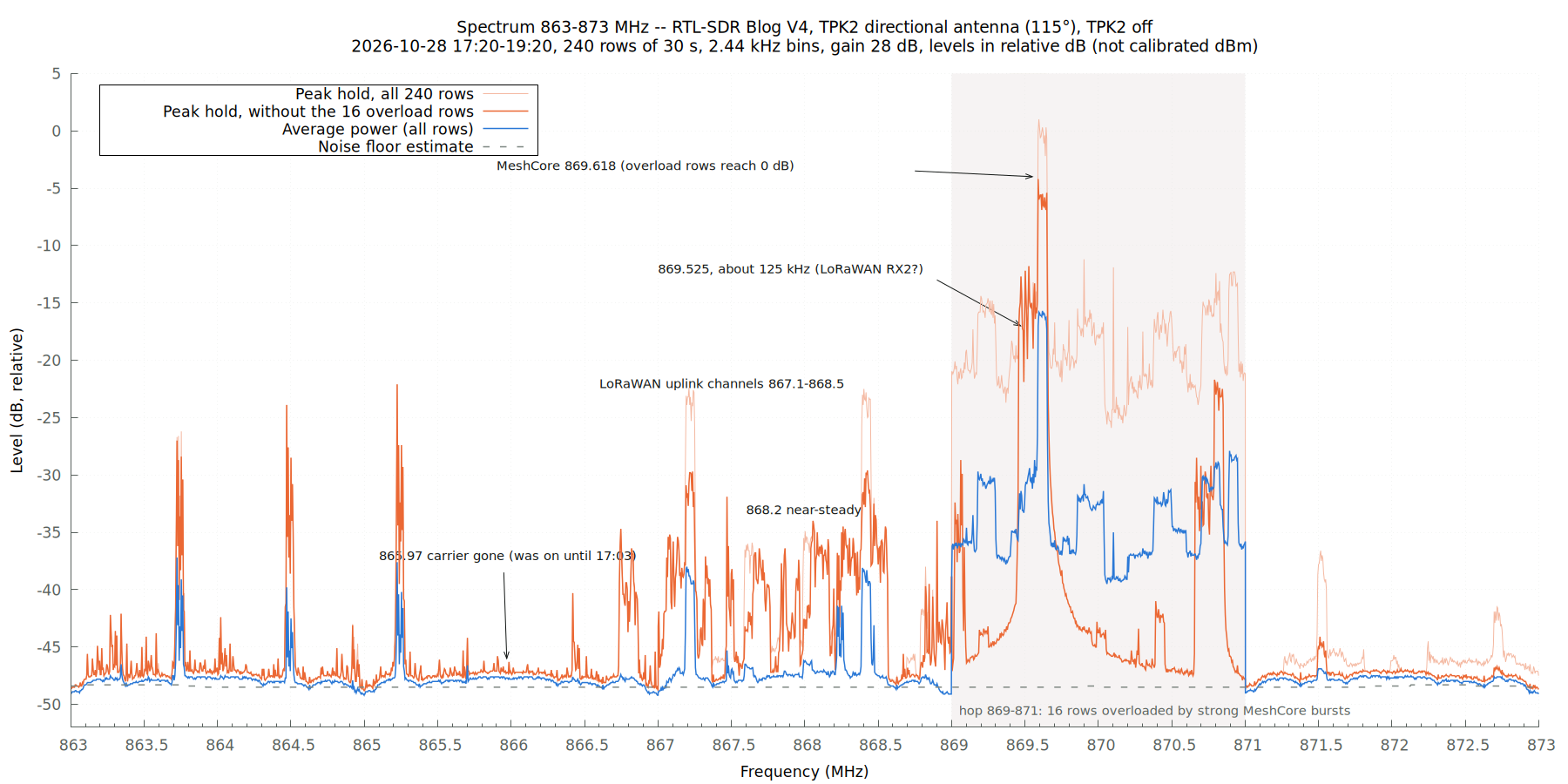
Light red: peak hold over all 240 rows. Red: peak hold without the 16 overload rows. Blue: average power. Grey dashes: noise floor estimate.
Zoom: 869.3–869.8 MHz
What showed up
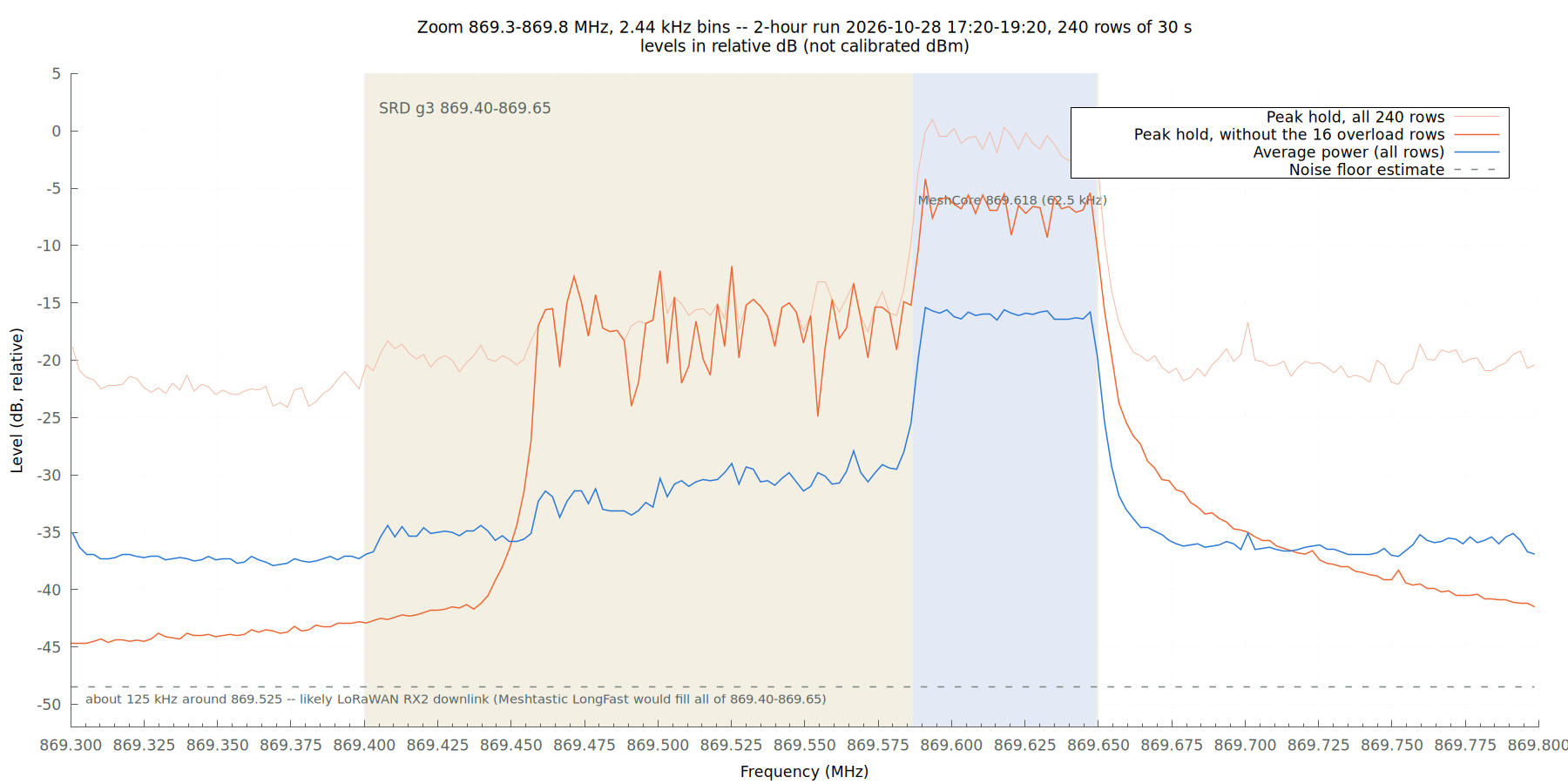
- MeshCore on 869.618 MHz (62.5 kHz wide) was the strongest signal, about 43 dB above the floor.
- About 125 kHz of activity around 869.525 MHz, in 27–40 % of rows. That width fits the LoRaWAN downlink channel RX2 (869.525 MHz, 125 kHz) better than Meshtastic LongFast, which is 250 kHz wide. The signals were not decoded, so this is not confirmed.
- LoRaWAN uplink channels 867.1–868.5 MHz show bursts all through the run.
- 868.20–868.27 MHz: a weak signal (+7 to +14 dB) in about 77 % of rows.
- 865.97 MHz: a steady carrier seen in earlier runs switched off at about 17:03 and stayed off for this whole run.
SDR overload
In 16 of the 240 rows a very strong MeshCore burst overloaded the SDR. The whole 869–871 MHz hop then rose by 20–28 dB, and false lines appeared in the neighbouring hop, for example near 867.1, 867.9 and 868.4 MHz. These rows show as full-width stripes in the waterfall. The plots show the peak hold both with and without them. This band is where the Sysmocom CF868 cavity filter passes signals through.
Data
rtl_power output, 5 hops of 2 MHz, one line per hop per 30 s. Gzip-compressed CSV.